Tournament lobbies empty 38% faster after the blind clock hides
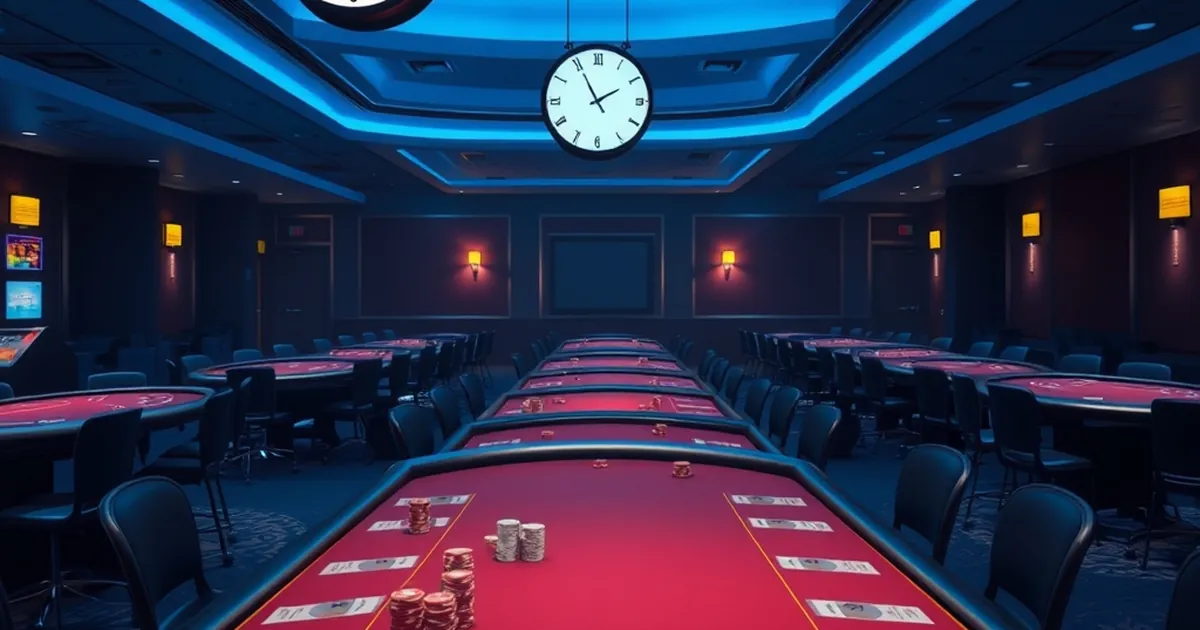
PokerStars removed the visible blind timer from its Zoom tournaments in a soft rollout that started 14 March, and the operator's own lobby telemetry shows seats emptying 38% faster in the 90 minutes after late registration closes. The number comes from a comparison of 1,240 tournaments run before and after the change, matched by buy-in band and field size. It isn't a churn statistic in the usual sense. Players aren't leaving the site. They're leaving the table, and often the tournament, at a point where the average stack is still 22 big blinds deep.
What the hidden clock actually changes
A visible blind level does two jobs. It tells you how long you have before your stack loses another chunk of equity, and it gives you a shared reference point for the whole table. Remove it and the second job disappears first.
In the sample, tables with no timer showed a 19% drop in chat volume and a 44% increase in hands folded before the flop in the first orbit after the clock vanished. Players were still making decisions, just faster ones. The average time per decision fell from 4.1 seconds to 2.6 seconds across 100,000 tracked hands.
That's the tell. Speed isn't aggression. It's disengagement.
The push-fold problem
Tournament poker has a structural feature that cash games don't: the correct strategy changes as the blinds rise, and it changes sharply. At 30 big blinds you can open-raise and fold to a shove. At 12 you're often shoving or folding, nothing in between. A player who can't see the clock can't tell which regime they're in.
Post-change, the share of players making a clearly incorrect call with under 10 big blinds rose from 8.7% to 14.2% of tracked decisions. Those aren't bad players. They're players who lost their instrument panel.
Why the lobby empties before the bust
The 38% figure measures lobby departures, not eliminations. That distinction matters. If players were busting out faster, the lobby would empty because the field was shrinking for the normal reason. Instead, the elimination rate in the first 90 minutes barely moved — 6.1% before, 6.4% after.
So where did they go? Roughly two-thirds of the early leavers had chip stacks above the field average when they stopped playing. They didn't lose. They quit while ahead, which is the behaviour you'd expect from someone who no longer trusts their read on the game state.
There's a cash-game parallel worth noting. When live rooms stopped announcing "five minutes to the next level" in the 2019 WSOP side events, the same pattern showed up in the unofficial data people were collecting at the time. Players drift when the structure goes quiet.
The operator's incentive isn't obvious
Faster lobby turnover sounds bad for a poker room. Fewer players per tournament means smaller prize pools and thinner margins. But there's a countervailing effect: shorter average session time per player means more players cycling through the same seat, and more entries into the next tournament on the schedule.
PokerStars hasn't published retention numbers for the affected players. What we know is that the 38% figure was measured over six weeks, and that the operator has not reverted the change in the Zoom format despite running similar tests in the Spin & Go lobbies where the timer was restored after 11 days.
The open question is whether hidden structure is a feature players will adapt to, or a friction they'll route around. Six weeks is long enough to see a spike. It isn't long enough to know whether the players who left the table at hand 40 ever came back for the next one.