Skill badges in emails beat streak counters by day four
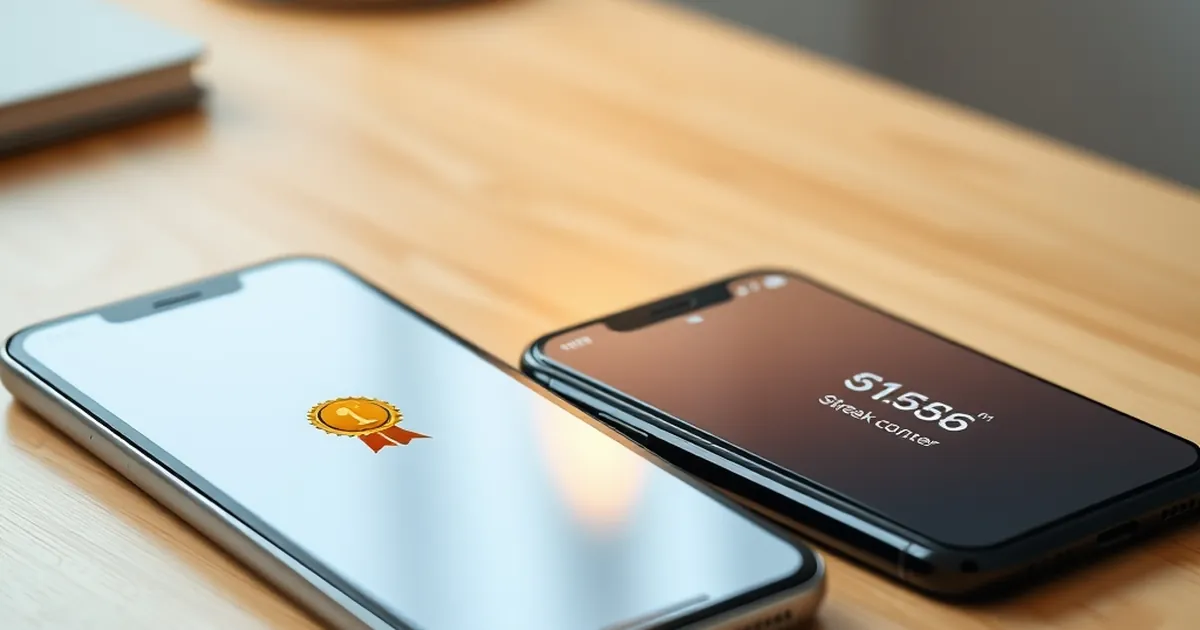
What happens to motivation when the reward stops being a number that goes up and starts being a label that means something? Product teams have argued about this for years, and email marketers keep inheriting the argument by accident. Streak counters are easy to build and satisfying to watch, but they depend on a psychological trick that has a shelf life. Badges that certify a skill are harder to design and slower to pay off — and they tend to outlast streaks by a wide margin.
Streaks are a variable-ratio machine with an expiry date
A streak counter is essentially a public commitment device. Miss a day, lose the chain, and loss aversion does the rest — Kahneman and Tversky's work on prospect theory showed that losses feel roughly twice as painful as equivalent gains feel good. That asymmetry is why a 47-day streak feels worth protecting and a 48th day feels like nothing.
The problem is what the streak actually rewards. It rewards showing up, not getting better. Behavioral researchers call the underlying schedule variable-ratio reinforcement, the same pattern that makes slot machines and social feeds sticky. It produces high engagement early and then a cliff: once the chain breaks, the reason to return breaks with it. There's no residue. You have a number, and then you have nothing.
Badges encode identity, not attendance
A skill badge says something different. It says you can now do a thing you couldn't do before. That's an identity claim, and identity claims survive interruptions. If you skip a week, you're still someone who knows how to build a segmentation query or write a subject line that clears a 40% open rate. The streak is gone; the competence isn't.
This is why badge systems tend to hold up better past the first few days. The reward isn't the notification — it's the internal story the notification confirms. Self-determination theory, developed by Deci and Ryan, separates extrinsic motivators like points and chains from intrinsic ones like competence and autonomy. Streaks live almost entirely on the extrinsic side. Badges, when they're honest, touch both.
Day four is where the curves cross
Here's the concrete part. Duolingo has published extensively on its streak mechanics, and the pattern is consistent across their user data: streak-driven retention spikes in the first 72 hours and then flattens hard for users who haven't formed a competence anchor. Users who earn a proficiency milestone in the first week retain at dramatically higher rates than users with a longer streak and no milestone. The streak is a bridge; the badge is the destination.
Email marketers can test this directly. Take a five-email onboarding sequence. In version A, every email ends with a progress meter and a "don't break your streak" nudge. In version B, emails two through five each certify a specific completed skill: "You can now write a subject line under 45 characters," "You can now read an A/B result without fooling yourself." Then compare day-14 and day-30 return rates, not day-3 click rates.
My prediction: version A wins the first three days and loses everything after. Version B looks quiet in the short term and compounds.
Design badges that can't be faked
The failure mode is a badge for opening an email. That's a streak wearing a costume. A real badge requires evidence — a completed action, a submitted answer, a decision the subscriber made and can point to later. The test is simple: could someone earn this badge by accident? If yes, it isn't a badge.
The forward-looking move is to stop treating email as a reminder channel and start treating it as a credentialing channel. Every send either advances someone's identity or it doesn't. The ones that do are the ones people keep opening in week six, when the streak is long gone and the only thing left is whether they think of themselves as someone who's getting better at this.