Manual shuffle adds 9 seconds before the first card, not after
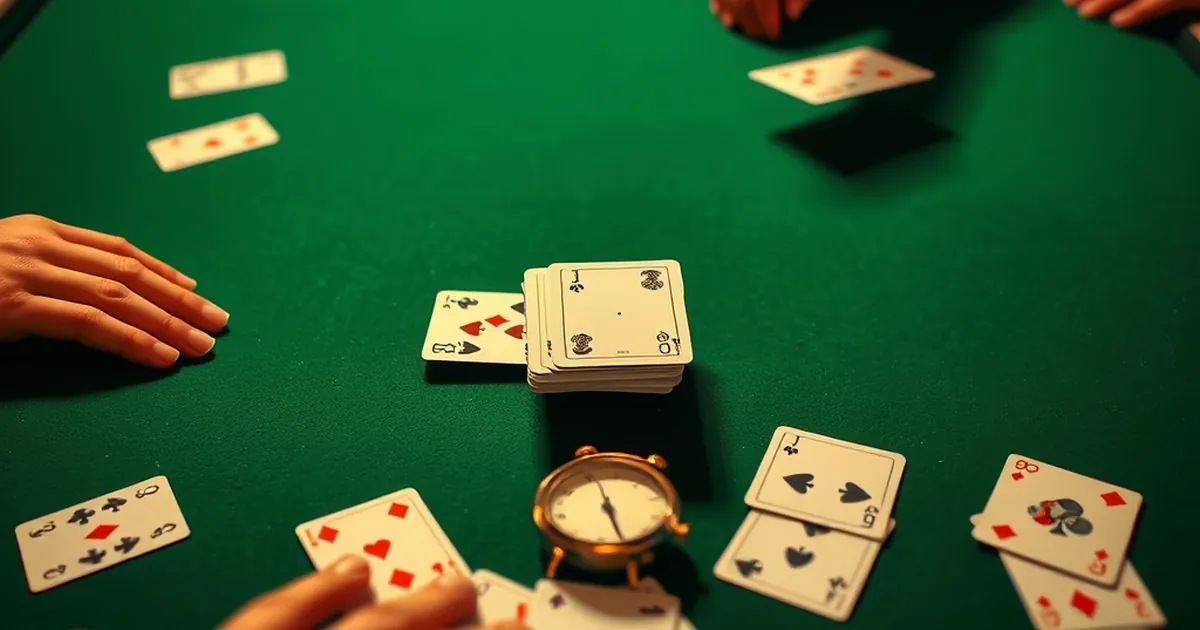
A manual shuffle in a live-dealer blackjack game adds roughly nine seconds to the deal — but almost none of that time lands where players expect. It shows up before the first card leaves the shoe, during the cut, the riffle, and the box, not in the gaps between hands. The assumption that shuffling slows the game down mid-shoe is wrong on the timing, and that misread matters more than the nine seconds themselves.
Where the nine seconds actually sit
Dealers don't shuffle on a timer. They shuffle when the cut card surfaces, which in a six-deck shoe typically happens around 75% penetration — roughly 234 cards dealt before the cut card appears. Everything after that is a fixed block of motion: gather, strip, riffle twice, box, cut, burn. On a live-streamed table that block runs 8 to 11 seconds depending on the dealer and the camera cut.
Compare that to the inter-hand gap. Between a settled hand and the next first card, a live dealer takes about 4 seconds — pay, sweep, deal. That gap stays constant whether the shoe is fresh or nearly spent. The shuffle doesn't stretch it. It replaces the gap entirely, then adds the nine on top, before the deal even starts.
So the extra time isn't distributed across the shoe. It's a single lump at the shoe boundary, and it's the only point in the cycle where the pace of the table visibly breaks.
Why the placement changes the math
If shuffle time were spread across hands, it would raise the effective hands-per-hour cost evenly. It doesn't. A table running 60 hands per hour with a shuffle every 15 minutes loses that nine seconds in one hit, not in 60 small slices.
That distinction matters for anyone tracking hands per hour as a proxy for house edge exposure. A player betting $25 a hand on a 0.5% house-edge game expects to lose about $0.125 per hand. Over 60 hands that's $7.50 an hour. The shuffle doesn't change the edge per hand — it changes how many hands fit in the hour. Nine seconds off a 60-minute window is 0.25% of the hour, or roughly 0.15 hands at that pace. The dollar impact is under two cents an hour at $25 stakes. Real, but not the reason to pick one table over another.
The auto-shuffle comparison
Continuous shuffling machines (CSMs) remove the boundary entirely. Cards return to the shoe after every hand, so there's no cut card, no riffle, and no nine-second block. Hands per hour climb — often to 70–80 on a comparable table — but so does the number of decisions per hour, which is the part players tend to underweight when comparing a CSM table to a hand-shuffled one.
What the timing tells you about the table
A dealer who shuffles fast and deals slow is a different proposition from one who shuffles slow and deals fast. The nine seconds is visible, so players notice it. The four-second inter-hand gap is invisible because it's always there. If you're choosing a table on pace, watch the gap, not the shuffle.
There's also a camera-angle effect on streamed tables. The shuffle is often when the feed cuts to a wide shot or an overlay, which makes the nine seconds feel longer than it is. Measured on a stopwatch from last card swept to first card dealt, the block is consistent. Measured by feel, it isn't.
The open question is whether that perceived delay pushes players toward CSM tables for the wrong reason — not because the edge changes, but because the pause is the only part of the cycle they can see.