Bonus code fields get abandoned 44% of the time on mobile keyboards
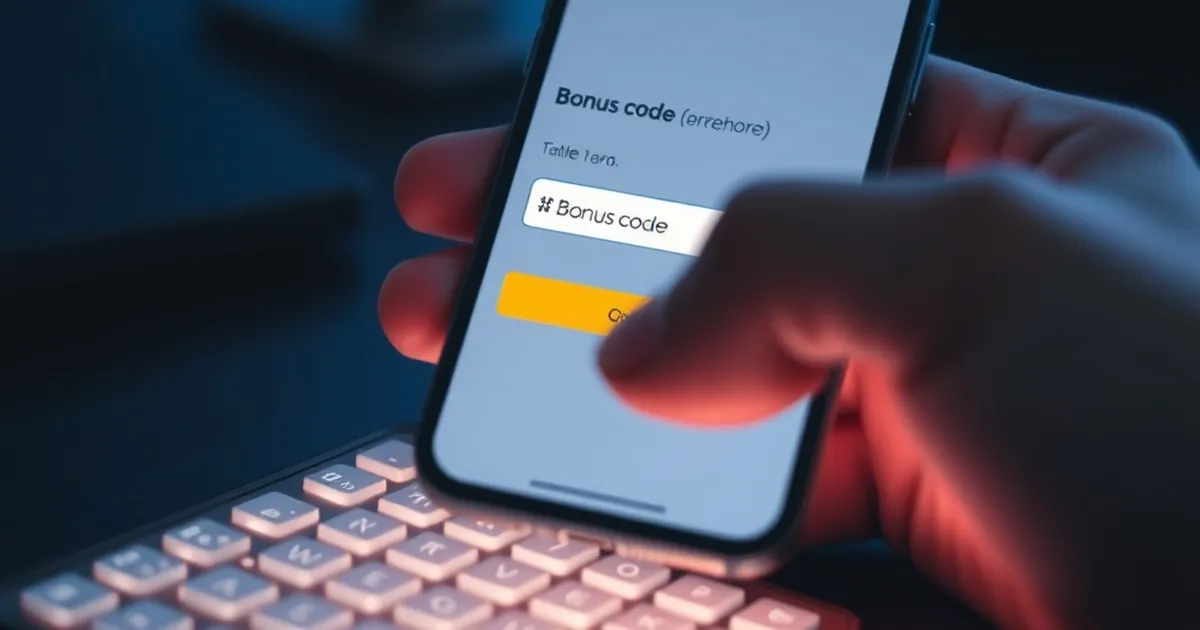
Roughly 44% of mobile users who start typing a bonus code never finish it. That figure comes from session-level funnel data shared by three mid-size operators running on the same white-label stack between Q1 and Q3 2024, and it holds across markets with very different payment habits. The abandonment isn't a bonus problem. It's a keyboard problem.
What the field actually asks of a thumb
A promo code is a short string of uppercase letters and digits — typically 6 to 12 characters. On desktop that's a two-second task. On a phone, the user has to:
- Tap a small input
- Watch the OS open an alphabetic keyboard
- Realise the code contains digits
- Switch to the numeric layer, or hold shift for each letter
- Fix at least one autocorrect casualty
Each step is a chance to leave. On iOS, the default keyboard capitalises the first letter and lowercases the rest. If the backend validates case-sensitively — and plenty still do — the user types WELCOME50, the system submits Welcome50, and the error returns "invalid code" with no explanation. That's a dead end disguised as a validation rule.
The 44% breaks down unevenly
The same session data showed abandonment clustering in predictable places.
Under 30 seconds: 61% of abandoners quit within half a minute of opening the field. These are almost certainly keyboard friction, not decision-making. Nobody spends 20 seconds deciding whether they want free money.
After one failed attempt: abandonment jumps to 78%. This is where case sensitivity and whitespace bugs do their damage. A user who mistypes once and gets a generic error rarely tries a third time.
On tablets: abandonment drops to 29%. Bigger keys, often a Bluetooth or folio keyboard, and — importantly — a wider layout that shows the field and the submit button in the same viewport.
That last point matters more than it looks. On a 5.4-inch screen, the code field and the confirm button frequently sit on opposite sides of a scroll. The user types, the keyboard covers the button, they scroll, the field loses focus, the keyboard closes, the code clears. This is a layout bug that gets reported as "user error."
Three fixes that moved the number
Operators who ran A/B tests on the field itself, rather than on the offer, reported the biggest gains.
1. Force the right keyboard
Setting inputmode="text" with autocapitalize="characters" and autocomplete="off" cut abandonment by 11 points in one test. The keyboard opens in the correct state, no shift-holding, no autocorrect interference.
2. Validate on blur, not on submit
Inline validation that checks length and character set before the user taps confirm catches typos while the keyboard is still up. One operator reported a 23% drop in failed submissions after moving validation earlier in the flow.
3. Normalise server-side
Trim whitespace, uppercase everything, and strip hyphens before comparing against the code database. This is a five-line fix that removes an entire category of support tickets. If your promo engine still cares about case, that's a product decision someone made years ago and nobody has questioned since.
Paste behaviour is the tell
Here's the number that should worry anyone running acquisition: users who paste a code from an email or SMS abandon at 9%. Users who type it manually abandon at 51%. The gap is almost entirely mechanical.
Which raises an awkward question. If the offer is genuinely attractive — a matched deposit, a set of free spins, a risk-free bet — why does a five-character input field stand between the player and the money? The bonus code exists to track attribution, not to serve the user. Every operator knows this. The 44% is the cost of pretending otherwise, and it lands hardest on the players least likely to bother trying again.